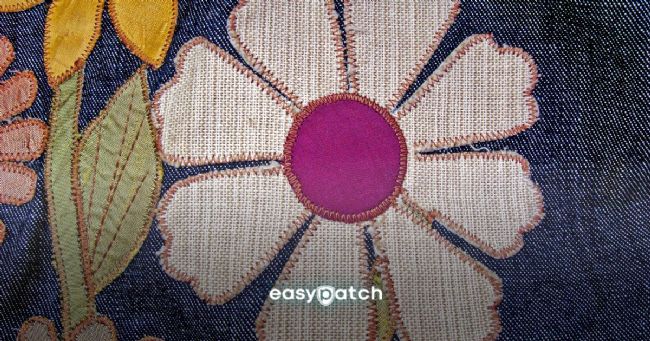
Vintage patches are not mere decorative elements. They tell a story, evokea precise aesthetic and transform an anonymous garment into something personal and recognisable. Precisely because of this, applying them the wrong way can ruin not only the patch, but also the fabric to which it is attached. Many mistakes arise from the idea that a vintage patch applies like any modern patch. In reality, materials, thicknesses and aesthetics require more attention. In this EasyPatch guide we analyse the most common mistakes to avoid when applying vintage patches and how to prevent them in order to achieve a clean, consistent and long-lasting result.
Why vintage patches need more attention
Vintage, or vintage-inspired, patches often feature thicker embroidery, natural fabrics, less rigid edges and adeliberately imperfect aesthetic. This means that they react differently to heat, pressure and stress than modernPVC or standard thermoadhesivepatches. Treating them like any other patch is the first step towards an unconvincing result. Applying a vintage patch means respecting its character and adapting the technique to the context.
Mistakes to avoid before applying vintage patches
One of the most frequent mistakes is not preparing the garment on which the patch will be applied. Dirty, wrinkled fabrics or fabrics with softening agent residues compromise adhesion and the final result. Before applying a vintage patch, it is always advisable to wash the garment, dry it properly and iron it to obtain an even surface.
Another common mistake is not checking the compatibility between patch and fabric. Not all materials react in the same way to heat. Applying a vintage thermoadhesive patch to a delicate fabric without prior testing can cause halos, warping or even burning. Doing a test on a hidden area of the garment helps to avoid irreversible damage.
The wrong choice of fixing systemis also one of the initial mistakes. Not all vintage patches are designed to be heat-adhesive. Forcing heat onto a patch that would be better sewn on risks compromising its aesthetics and durability.
Mistakes during actual application
One of the most underestimated mistakes is moving the patch while applying heat. Even a small movement can create creases, misalignments or areas that do not adhere properly. A vintage patch must be precisely positioned before starting and held in place throughout the application.
Another frequent mistake is to focus only on the central part of the patch, neglecting the edges. The edges are the most critical area, especially in embroidered patches with thick details or irregular shapes. If they do not receive sufficient pressure and heat, they will tend to lift over time, ruining the final effect.
Applyingtoo much heat or for too long is equally risky. The result can be a stiffened, discoloured fabric or a patch that loses its original texture. Conversely, applying too quickly does not allow the adhesive to set properly. The balance between temperature, pressure and time is crucial.
Mistakes related to the type of fabric
Every fabric has its own response to heat and pressure. Applying a vintage patch on denim is often not the same as applying it on light cotton or a mixed fabric. A common mistake is to use the same technique on different garments without adapting it. This leads to inconsistent results and sealing problems over time. The same rule also applies to the fabric of the patches themselves: if a leather patch requires a certain technique, this will certainly be completely different from the technique for applying a fabric patch.
On delicate fabrics, a frequent mistake is not to use a protector between iron and patch. Direct contact can compromise both the embroidery and the fabric. Even on strong materials, a protector helps to distribute heat more evenly.
Maintenance errors after application
Many problems do not arise during application, but immediately afterwards. One of the most common mistakes is washing the garment too soon. The adhesive, especially in vintage thermoadhesive patches, needs time to fully stabilise. Immediate washing increases the risk of detachment.
Aggressive washing isalso the enemy of vintage patches. High temperatures, intense spinning and tumble dryers can weaken the adhesion and ruin the embroidery. Neglecting the washing instructions means drastically reducing the life of the patch.
How to avoid the most common mistakes
To achieve a professional result, it is essential to start with good preparation. A clean garment, a smooth surface and a conscious choice of fastening method are the basis. During application, precision and calmness make the difference. Uniform pressure, attention to edges and adherence to timing help avoid future problems.
In many cases, especially with vintage patches intended for heavily used garments, a small reinforcement with a seam along the edge may be the wisest choice. It does not alter the aesthetics and significantly increases the durability of the application.
Frequently asked questions about vintage patches and application
What are the most common mistakes in the application of vintage patches?
The most common are not preparing the fabric properly, using the wrong temperature, not paying attention to the edges and washing too early after application.
Should vintage patches always be sewn on?
Not always, but in many cases sewing is the safest solution. It depends on the type of patch, the fabric and the intended use of the garment.
Can I use an iron for all vintage patches?
Only if the patch and fabric allow it. It is always advisable to check compatibility first and test on a hidden area.
Why do the edges of vintage patches lift?
Usually due to a lack of pressure or even heat during application or too aggressive washing.
How can I increase the durability of a vintage patch?
By applying it correctly, respecting fixing times, avoiding aggressive washing and considering reinforcement with stitching at critical points.
Making vintage patches last over time
Applying a vintage patch is not a mechanical gesture, but a choice of style and care. Avoiding common mistakes means respecting the character of the patch and the garment to which it is applied. When technique and awareness meet, the patch stops being a simple accessory and becomes an integral part of the fabric, destined to age along with the garment and tell an authentic story, use after use.