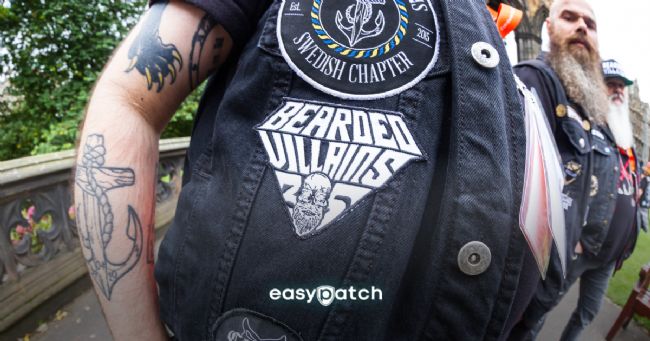
If you love motorbikes, you know that a jacket without patches is just a jacket. It is when badges, logos, names and symbols start to appear that your identity on the roadtakes shape . Motorbike patches are more than just decoration: they tell who you are, who you travel with, what miles you've travelled and what stories you carry.
In this guide, we at Easypatch want to take you inside the world of customised biker patches, explaining how to choose materials, styles, positions and fixing systems. The aim is to give you all the tools you need to design truly effective biker patches that work both aesthetically and practically on leather jackets, denim waistcoats and technical clothing.
What are motorbike patches and why they really matter
A motorbike patch is, on the surface, a simple piece of fabric or plastic material applied to jackets, waistcoats and accessories. In reality, it is much more: it is a visual language. Through the patches, in fact, motorcyclists communicate their membership of a club, their role within a group, their personal style and tell the story of rallies, trips and events that have marked their history.
Each biker patch has its own weight: some are more official and represent a club, others are decorative or ironic, others are reminders of a rally or a particular trip. When you design your own set of motorbike patches, you are building a story that others will read before they even speak to you.
History, culture and significance of motorbike patches
Biker patches originated in the world of American-inspiredclubs and brotherhoods . Leather jackets and denim waistcoats became canvases on which symbols, names, cities and mottos were sewn. Over time, this language also reached tourist motorbike clubs, Vespa clubs, groups of friends and free bikers who move outside the logic of traditional clubs.
Today, biker patches move on three levels:
- structured club and motorbike clubidentities;
- informal group identity, such as tour companies, crews or social groups;
- personal identity of the individual biker.
Understanding this context is crucial to designing patches that are respectful, consistent and credible. Every symbol you wear communicates something, even when you don't realise it.
Types of biker patches
Not all biker patches are the same. We can distinguish different types according to position, function and style.
Patches for jackets and waistcoats
On motorbike jackets and waistcoats, patches are distributed in fairly codified areas
- chest: name, nickname, role, small flags, small icons
- back: the famous back patch, often the largest and most significant one
- shoulders and arms: emblems, flags, logos, event and rally patches
When designing a complete set of motorbike patches, it makes sense to think about the whole thing: how front patches, back patches and secondary patches talk to each other.
Patches for clubs, motorbike clubs and groups
Club patches often have aprecise organisation: club name, city, central logo, possible membership indication. This is an area where respect is paramount. If you are creating patches for a new motorbike club, we advise you to carefully define
- the symbolism you will use
- the structure of the back patch
- the visual difference between members, sympathisers, internal roles
For more informal groups, the patch can be freer, but still be a distinctive sign.
Free biker patches and street use
Many bikers do not belong to a club, but use patches to express their own style: ironic phrases, classic symbols such as skulls, eagles, pistons and flags, memories of rallies or trips. In this area, the rules are more elastic, but a common sense rule applies : choose symbols that really represent you and avoid imitating patches of existing clubs.
Structure of back patches: rocker, centre and codes
The back patch is the heart of the biker aesthetic. In the most structured contexts it consists of three elements:
- top rocker: upper arch with club name
- centre patch: main logo
- bottom rocker: lower arch with city, area or definition
This structure is strongly characterised and has its own history. If you are creating motorbike patches for a new club, we encourage you to design an original design, without copying configurations and symbols from existing clubs. It is not only a question of style, but also of respect.
For touring or free bikeruse, you can instead choose a large, unique back patch, without rocker, with a strong, recognisable central logo: a skull, an eagle, a winged wheel, an abstract symbol, a graphic composition that speaks of you.
Symbols, designs and phrases in motorbike patches
The world of motorbike patches is full of recurring symbols that, over the years, have become true classics, such as skulls, crossbones, helmets and masks, eagles and spread wings and other totemic animals, but also engines, spanners, flames, dice, playing cards and references to anoften cutting irony, right up to the most explicit black humour.
Alongside this iconography , more identity elementscome into play , such as national or regional flags, references to the city or area they belong to, the year the group was founded, a motto, a symbolic phrase or a quote that encapsulates the spirit of the biker or motorbike club. When designing your motorbike patches, the real challenge is to find a balance between what really represents you and what others can interpret clearly and correctly: it is best to avoid symbols that you are not familiar with or that may be ambiguous, because an effective patch must communicate immediately, leaving no room for misunderstandings.
Materials and techniques for motorbike patches
The choice of materials for motorbike patches is crucial, as these must withstand sun, rain, wind and temperature changes, as well as blend in with the style of the jacket. Embroidered patches are the great classic: they have a traditional textile look, are very durable and versatile on leather, jeans and mixed fabrics, and are ideal for club badges, back patches and chest lettering, thanks to sharp contours and clear lettering. When the design is very detailed, with micro-texts or complex graphics, it is best to go for high-definition woven patches or patches printed on fabric, which retain legibility even in small sizes, perfect for small chest patches or event souvenir patches. Patches made of PVC, silicone and rubberized materials offer a more technical look, with 2D or 3D embossing, high resistance to rain, mud and dirt and a very readable design, ideal for technical jackets, tactical waistcoats, side bags and backpacks, while on leather they create a more modern contrast. Chenille, on the other hand, gives asoft, college-styleaesthetic, suitable for sweatshirts, casual jackets and statement garments, while leather patches complement leather jackets and waistcoats perfectly, tone-on-tone or contrasting, and can be engraved or embossed, making them perfect for minimal logos and essential symbols.
Frequently asked questions about motorbike patches
How do I put patches on my motorbike jacket?
The safest method is by stitching. For leather jackets and denim waistcoats, it is best to use a tailor or a specialised service that knows how to work with thick materials. Heat-adhesive patches can help to temporarily fix the patch in the correct position, but it is often advisable to add a seam along the edge for a really firm hold.
Is it better to sew or iron patches on leather?
On leather, it is almost always better to sew. The heat required for heat-setting may damage some types of leather or not guarantee an optimal hold over time. A well-made seam, even on the inside, is more reliable and reduces the risk of the patch coming off.
What size should a biker back patch be?
There is no one size fits all, but in general the back patch takes up an important part of the back of the jacket or waistcoat, without reaching the edges. It is best to measure the back of the garment and design the patch accordingly, leaving adequate margins so that the jacket remains visually balanced.
Can I use any symbol on motorbike patches?
From a technical point of view, yes, but it is important to carefully evaluate the symbolism. Avoid copying existing club logos or using symbols you are not familiar with. Some graphics have precise meanings within the biker world and might communicate something different from what you intend.
Can you make customised motorbike patches for your motorbike club?
Absolutely. It is one of the most frequent requests. You can design the logo, lettering and patch structure and create a coordinated set for all motorbike club members, possibly with variations for different roles or chapters.
Do patches resist rain and washing?
If made of quality materials and applied correctly, motorbike patches withstand rain, wind and moderate washing well. However, it is advisable to follow specific washing instructions for the jacket or waistcoat, avoid excessively aggressive cycles and, when possible, prefer gentle or hand washing.
Patches as a travelogue on two wheels
In the end, motorbike patches are much more than an accessory. Each patch tells a piece of the road: the first motorbike club, the gathering far away, the friendship born during a trip, the city you consider home even when you are hundreds of kilometres away.
Building your own set of patches is a work of identity and memory. It means choosing what to show, what to remember and how to do it. With the right materials, a neat design and a well-made fastening, motorbike patches become a second skin for your jacket or waistcoat, and a way to say to other motorcyclists, without speaking, 'this is my story, this is my way'.