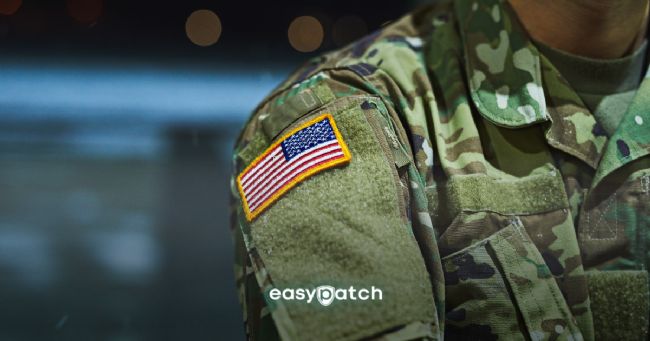
Customised military patches are not just decoration: they tell the story of belonging, role, history of the department or team. Whether you use them on operational uniforms, softair equipment, tactical backpacks or for collection, the way they are designed and made completely changes the perception of your team. In this guide by Easypatch we summarise the key points for consciously choosing materials, styles and fastening systems, so that you get military patches that really fit your needs.
What makes a military patch unique
An effective military patch is not only aesthetically pleasing: it must be clear, recognisable and consistent with actual use. It can condense department, flag and nation, name, motto or references to missions or courses into a few centimetres.
In the modern world, military patches live on three major fronts: operational uniforms and vests, tactical equipment and clothing, collectibles and patches for softair and enthusiasts. This requires a technical approach to the choice of materials and styles, not just an aesthetic one.
The main types of military patches
For military patches, there are different materials, each with its own personality.
Embroidered patches are the most traditional version. Textile base and thread design make them ideal for departmentalbadges, armbands, flags and more institutional badges. They communicate solidity, seriousness and continuity with the uniform tradition.
High definition woven patches are perfect when you have very detailed logos or small lettering. The dense weave allows for a sharp rendering even on small sizes, while still maintaining a textile and neat appearance.
Fabric-printed patches come into play when nuances, illustrated effects or almost photographic imagesare required . They are suitable for complex emblems, creative logos and graphics that embroidery could not render faithfully.
PVC, TPU or silicone patches, on the other hand, represent the more contemporary tactical style. They are the classic rubberised embossed patches, very robust, with solid colours and sharp lines. They are perfect on plate carriers, backpacks, waistcoats and technical caps, especially in the softair and outdoor world. Some variants can also be luminescent, for a glow effect in low light conditions.
Chenille and leather cover the borderline between military and lifestyle. Chenille offers a soft, volumetric look, ideal for largenumbers and letters in college style: it works very well for jackets, sweatshirts and representative garments of schools, academies and sports departments. Leather, engraved or embossed, on the other hand, gives a more heritage and premium character, perfect for military-inspired hats, jackets and accessories.
Back and fastening systems for military patches
The back is just as important as the front. It determines how you will use the patch and how practical it will be in everyday life.
Velcro is the standard in the military and softair world. A male Velcro patch on the back is applied to a female Velcro base on vests, plate carriers, backpacks or caps. This allows you to change flag, name or department in seconds, without sewing and without damaging the garments. It is the ideal solution when the information is not fixed in time.
Sew-on patches are the most traditional and definitive choice. The border is made to be sewn directly onto the garment: perfect for jackets, caps, representative uniforms and garments that do not require frequent patch replacement. It offers a very high level of stability, particularly useful for garments that undergo many washes.
Heat-sealable patches use a thermal adhesive on the back that is activated with an iron or press. They work very well on textile patches and garments that withstand medium to high temperatures. They are particularly useful when you have to apply many patches in series on uniforms, sweatshirts or jerseys. For more demanding situations, it is advisable to combine the thermoadhesive with a reinforcing seam on the edge.
Finally, there are adhesive solutions, magnetic or turned into embroidered or PVC key rings. With the same military design, you can create stickers for hard surfaces, magnets for cupboards and refrigerators or key rings for everyday use. It is an easy way to bring your group identity to life even outside the operational context.
Customisation and visual appeal
Once you have chosen the base type to start with, the level of customisation comes into play.
The 3D effect is one of the most popular. It can be achieved on embroidery or PVC, giving prominence to a key element of the logo: skulls, animals, symbols, departmental initials. The result is a patch that stands out both visually and to the touch.
Fluorescent or glow-in-the-darkeffects are ideal for patches that need to be visible in the dark or that focus on a high-impact look for softair. Some materials are able to charge with light and render sufficient luminescence in dimly lit environments.
On chenille you can work on several layers of felt to create depth effects. On leather you can choose between more discreet engraving or marked relief, resulting in very different styles even with the same logo.
How to design a military patch that really works
A good design starts with a simple question: what is the patch for? If it is operational, function comes first: name, blood group, flag and department must be legible from a distance. Better clean shapes, clear fonts and colour palettes consistent with the uniform or equipment.
If it is a moral or collector's patch, you can go further with creativity, effects 3D, strong colours and specialmaterials. The form can be freer, even shaped, and the content more elaborate.
In any case, you should
- choose a shape suitable for the location;
- always check the readability of key information
- decide whether you prefer high visibility or low profile depending on the context.
If you do not have a final graphic file, you can still start with a sketch or an idea: the important thing is to clarify the objective, style and context of use.
Who customised military patches are for
Military patches today speak to a wide audience. They are requested by departments and police forces, schools and academies, but also by softair teams, tactical clubs, sports groups, voluntary associations and collectors. The same visual language is used in different ways:
- serious and institutional on uniforms
- technical and aggressive on tactical equipment;
- creative and ironic on moral patches on waistcoats or backpacks;
- refined and vintage on leather and premium fabrics for lifestyle garments;
The key is always the same: consistency between who you are, where you will use the patch and what you want to communicate.
Frequently asked questions about military patches
Are embroidered or PVC patches better for military or softair use?
It depends on the context. Embroidery is more traditional and suitable for coats of arms and institutional badges. PVC is more rubberized, modern and durable, ideal for tactical and softair equipment. If you are looking for a technical look, PVC is often the most straightforward choice.
Why is Velcro so popular on military patches?
Because it allows the patch to be replaced in seconds without sewing. It is the best solution when you change flag, call sign or department often, or when the same jacket is used for different patch configurations.
Is thermoadhesive also suitable for uniforms?
It can be, if they are fabric garments that can withstand ironing at medium-high temperatures. It is convenient for quick applications on a series of uniforms, but on garments subjected to a lot of stress, it is useful to add a reinforcing seam as well.
Can I have military patches with my name and blood group?
Yes, this is one of the most common uses. Name patches can include flag, blood group and other essential data, while maintaining a compact and readable format, usually rectangular or Combat ID type.
If I don't have a logo ready, can I still order military patches?
Of course. The important thing is to be clear about the message and style you want to achieve. From there you can work on a technical graphic proposal suitable for the chosen material, respecting size, legibility and production yield limits.
Give character to your equipment
Military patches are one of the most visible elements of a uniform, tactical waistcoat or backpack. A carefully designed patch in terms of material, style and fastening system can transform a neutral garment into a strong and recognisable symbol of belonging. By consciously choosing from embroidery, PVC, HD fabrics, chenille, leather, Velcro, stitching, thermoadhesive and the various customisations available, you can create military patches that are not just an accessory, but a true extension of your operational, sporting or personalidentity.